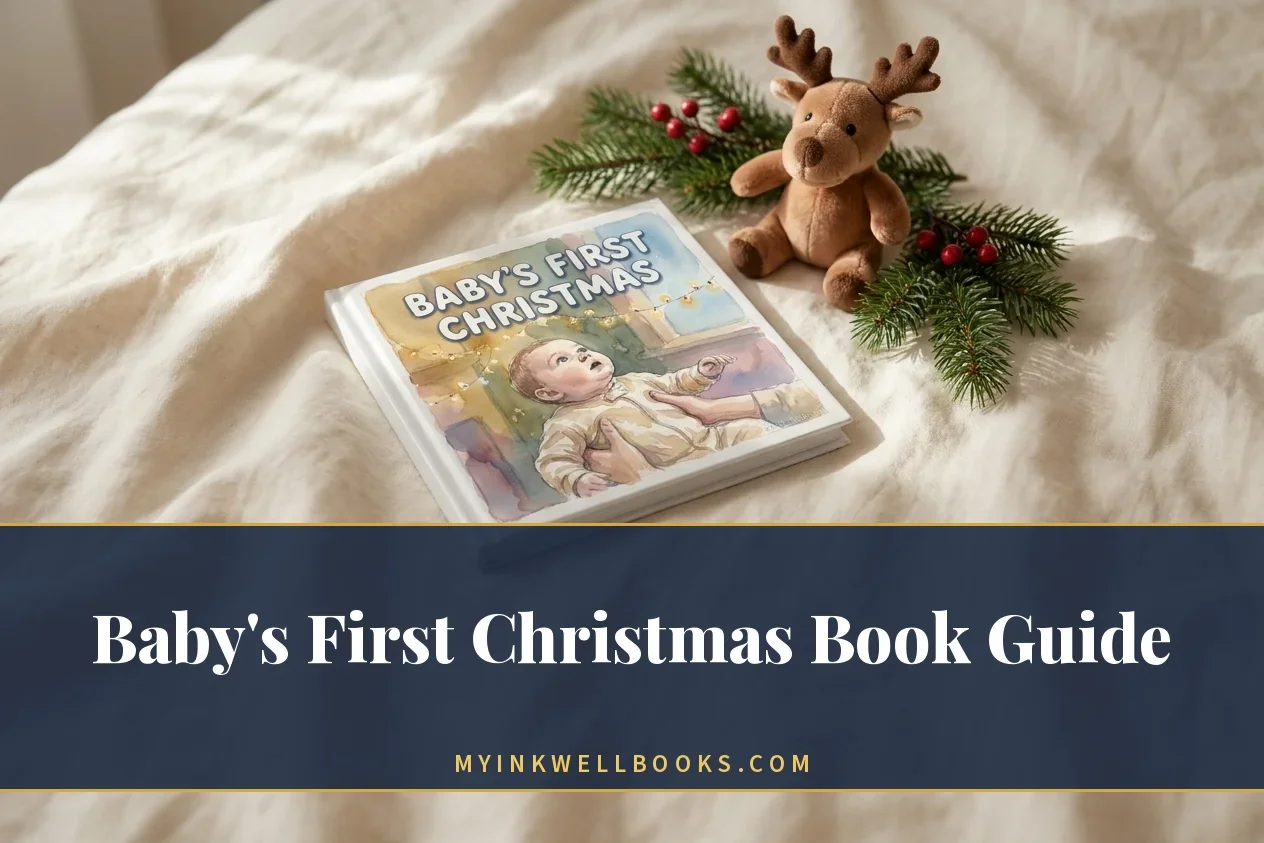
Your baby won't remember the first ornament, the dog sniffing at the tree skirt, or the way Grandpa held her at Christmas dinner like a carton of eggs he'd been told not to drop. You will, for a while. Then the details slide into a camera roll full of photos that all show the same blurry living room.
A first-Christmas book keeps the details, if you choose them well. Here is what to put in one, who should tell it, and what to leave out.
Write it for next year's toddler
This December your baby will mostly chew the corner of the book. That's fine. The real reader is the toddler they'll be next year, pointing at a page and asking "is that me?" Write for that kid.
That means short pages: two rhyming lines, or one plain sentence, and a picture that does the rest. A page with a paragraph on it is a page that gets skipped at bedtime.
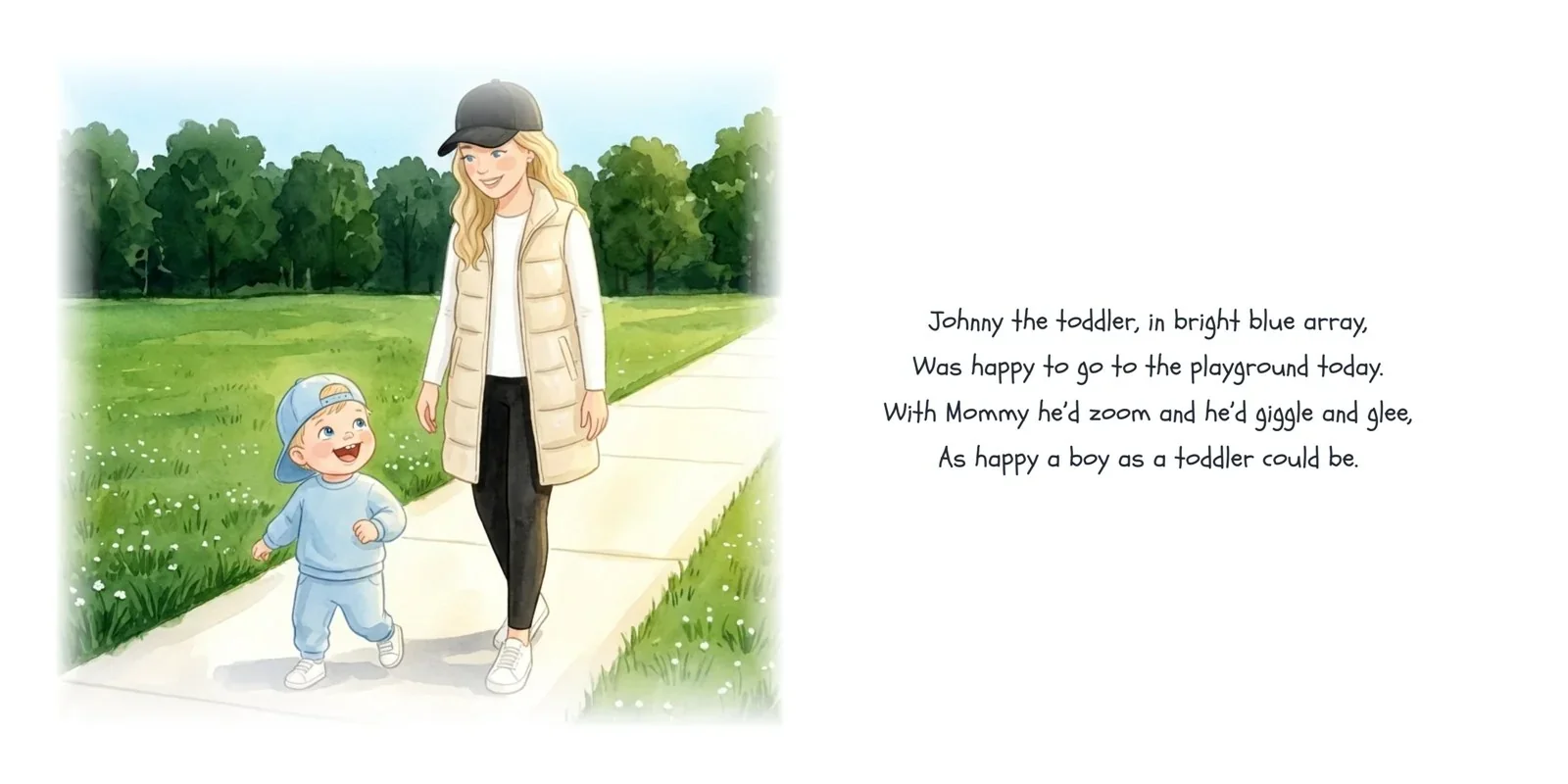
The pages that last are often the plain ones. This one is just a walk to the playground. Nothing happens on it, and it's still the page a family keeps. Your version is the walk around the block in the dark to see the neighbors' lights.
Twelve moments, not everything
Twelve moments is plenty: enough for the build-up, the day and the quiet after, without padding. Write the list before you write a single line. Some to borrow:
Before the day
- The tree goes up and the baby sees the lights for the first time.
- The dog inspects the tree and decides it belongs to him.
- The first trip outside in a snowsuit so big that only a face shows.
The day itself
- The wrapping paper turns out to be better than the present.
- Grandparents arrive with cold cheeks and full arms.
- The high chair gets pulled up to the table for the first time.
The quiet after
- Everyone is asleep in the same room by four o'clock.
- The thing only your family does: the pancakes, the song, the long drive home.
- A last page that is a wish. "Next year, you'll..."
Then swap each one for what actually happened at your house. Not "Grandma visits" but the coat she always wears and the cookie tin she never arrives without.
Who tells the story
The usual voice is a parent talking to the baby: "You saw your very first tree." It reads warmly aloud and it ages well. Two others are worth a try.
An older sibling or cousin. One family this fall told theirs from an older cousin's side. The baby can only grab a toy and smile, and the older child wants to know what the baby can do, and whether they'll always be this small. By the last page the older one has decided that their job is to teach. The shape fits a Christmas book, and the big kid gets a book that is partly theirs.
The pet. The dog has watched the whole month from under the tree, and a dog can be funny about the baby in a way a parent can't. "The small loud one got a stocking. I did not."
There are more ideas for siblings and the dog in our Christmas post for kids.
What to leave out
- The gift list. Nobody rereads an inventory. Keep one present, the one with a story attached.
- Every relative. A crowded page is a page of strangers to a two-year-old. Pick the two or three visitors who matter most and let the rest be a busy background.
- Dates and weights. Birth stats belong in the baby journal. This one is a story.
- The hard parts, unless they're funny. The sleepless week happened. The night the power went out and everyone ate cookies by flashlight is the version to keep.
Read it aloud once before you print. A line you stumble over now will trip you up every December after.
Start with your list
Take your twelve moments to a first-Christmas book of your own. Describe the baby, the visitors and the dog in your own words, no photos needed, then edit every line until it sounds like you and print it as a hardcover for the shelf. If you're a grandparent missing half the details, a gift card lets the parents make it themselves.