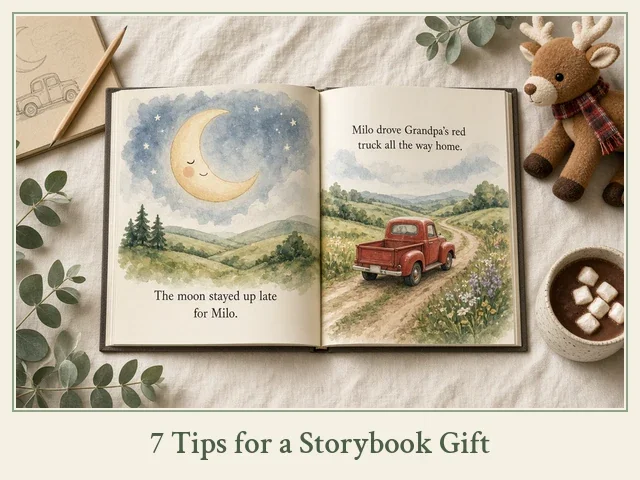
A personalized children's book sounds like the perfect gift until you open one that could belong to any kid with any name. The cover looks special. The middle pages feel like a template. If you're still choosing what the book should be about, these custom storybook gift ideas that go beyond the name on the cover are a good place to start.
A custom storybook that's still loved and reread after the holidays comes down to a handful of small choices you make before anything goes to print. Here are the seven that matter most, each with one idea you can borrow, whether the book is for Christmas, a birthday, a big change, or just bedtime. Most of them work just as well for a grown-up's book, too.
1. Start with one loud interest, not a whole biography
You don't need their life story. You need the thing they can't stop talking about this month.
Dinosaurs. Soccer. The rescue dog. Ballet class. Garbage trucks. Pick one and let the plot orbit it. A single clear interest makes the book feel current and specific. A list of every hobby makes it read like a form you filled out.
Ask yourself what would make them point at the page and say, "That's my thing."
One idea for a fifth birthday: if he runs to the window every Tuesday when the garbage truck comes, make him the driver's helper on your actual street. He waves to the neighbor with the red door, hauls the corner bin, and finishes the route in time for his own party. Years from now, that one obsession is what turns the book into a snapshot of who he was at five.
2. Put the relationship in the plot, not only on the dedication page
A sweet note inside the cover is lovely. It isn't the same as Grandma, Dad, or Auntie actually showing up in the story.
Here's how that could work when a parent has to be away. Say a mom is deploying, or a dad travels for work most of the spring. The book can follow their real bedtime routine: bath, two songs, the same silly goodnight, with the parent right there in every scene. The last page might be the two of them looking up at the same moon. Read each night while they're gone, it lets the child "see" that parent at bedtime.
Grandparents who live far away can do the same. Let Grandma know the secret path and wait at the end with cocoa, and the book does some of the visiting for her.
Magic Story leaves some room for this: you pick a story from its library, written by human authors, and some titles add a parent, grandparent, or pet. When you define the characters and the world yourself, the relationship drives the plot instead of joining one someone else wrote.
3. Pick a small, age-right problem the child can solve
Kids' stories need a little tension, not a crisis.
Lost toy. Can't reach the cookie jar. Afraid of the dark for five minutes, then brave. Keep the challenge sized to their world, and let them (or their character) figure it out.
Custom books really earn their keep during big changes. Give the story the same shape as what's coming:
- A new big sibling: the toddler teaches the new baby her favorite things, like how to stomp in puddles, which spoon is the good one, and where the dog likes to be scratched. It's a sweet book to give the day the baby comes home.
- The first day of kindergarten: walk through the actual school's routine. The bus stop at the corner, the cubby with her name on it, her teacher's real name, circle time, and Dad waiting at pickup. She's nervous at the classroom door and has a friend by snack time.
- A move across the country: tour the new house room by room before the boxes arrive. Here's where the bed goes, here's the window with the big tree, and here's the best spot for the old stuffed bear.
- A first plane trip to see cousins: the security line, the tiny window, the snack cart, and Grandma waiting at arrivals.
- Losing a grandparent: a gentle story where Grandpa still takes them out in the green canoe, the way he did every summer, gives a child a way to keep him close.
Kids handle new things better when they've already seen themselves do it in a story. A reassuring finish matters more than a twist. You're making a bedtime book, not a thriller.
4. Use the details only you know
Names matter. Nicknames matter more.
The way you call them "sunshine." The pet who steals socks. The blue blanket. The playground with the crooked slide. One or two of these do more than a dozen generic adjectives like "kind," "brave," and "curious" that could describe any child.
This works even before a child can read. One idea for a 2-year-old: build a simple story around his favorite words, one on each page. Truck. Moon. Uh-oh. Banana. When you pause before the word, he shouts it, and it feels to him like he's reading along.
You don't need a photo of your child's face, either. Interests, people, and places already make it theirs. Magic Story builds each book around an uploaded child photo, and Lullaby.ink makes one optional. A myInkwell book doesn't need one, which matters if you'd rather keep your kid's face off the internet.
5. Keep the cast short so bedtime stays easy
Every extra character is another name to track at 7:45 p.m. when someone's already yawning.
Most good custom books only need:
- The child, as the hero
- One or two people who matter (a parent, grandparent, sibling, or best friend)
- Maybe one pet or sidekick
That's enough. Crowd the pages with cousins, classmates, and every relative you can name, and the story gets harder to follow and harder to love on the twentieth read.
This matters most when the cast wants to be huge. Say a few parents want to give a kindergarten teacher an end-of-year gift starring the class. Twenty-two named kids won't fit, and nobody wants their child left out. One fix: make the teacher the hero, the class one cheerful crew called Room 12, and the class guinea pig the sidekick. The spring field trip to the apple orchard can be the adventure.
6. Choose a format you'll still want on the shelf
If you want it to outlast the wrapping paper, the object matters as much as the words.
Look for a real book: hardcover binding, thick pages, full-color print. Something built for sticky fingers and rereads, not a thin printout that curls by January. myInkwell books are 8.5-inch square hardcovers with thick matte pages, printed in full color on FSC-certified paper.
Think about a first birthday book. One idea: tell the baby the story of their first year, from the drive home from the hospital to the first taste of lemon to the wobbly first steps. A one-year-old won't follow the plot. At five they'll ask for it, and at fifteen they'll pretend not to care while reading every page. That's a lot of years for a book to survive.
StoryBook AI is built mostly for the screen, with digital comics and audio narration, and offers printed keepsakes as an extra. Lullaby.ink writes and illustrates a book from your description in minutes and is digital first, with softcover, hardcover, or layflat prints. Both are handy for lots of quick stories. For one book that lives next to the bed for years, print is the whole point, not an add-on.
7. Start early, and read it out loud before you order
Made-to-order books aren't sitting on a warehouse shelf. Start early for holiday delivery, and give yourself the same cushion for a birthday, a first day of school, or a baby's due date. Waiting until the last minute is how "the perfect gift" turns into "maybe next year."
Countdown books need the most cushion, because they get read before the holiday. One idea: an Advent story where the family's stuffed reindeer travels a little closer to the North Pole each night, read a bit at a time from December 1 until Christmas Eve. The same shape works for the eight nights of Hanukkah, with one small adventure for each candle.
Before you order, read the whole story out loud. Awkward phrasing shows up faster when you hear it, and you can still edit the text and redo individual illustrations at this stage. Check names and nicknames, and ask whether the adventure still matches the kid you know this year, not the kid from two Christmases ago.
The one they keep
A name on the cover can be cute. A story only you could write is the one they'll still ask for when the Advent calendar is recycled, the baby brother is walking, and the kindergarten jitters are long forgotten.